
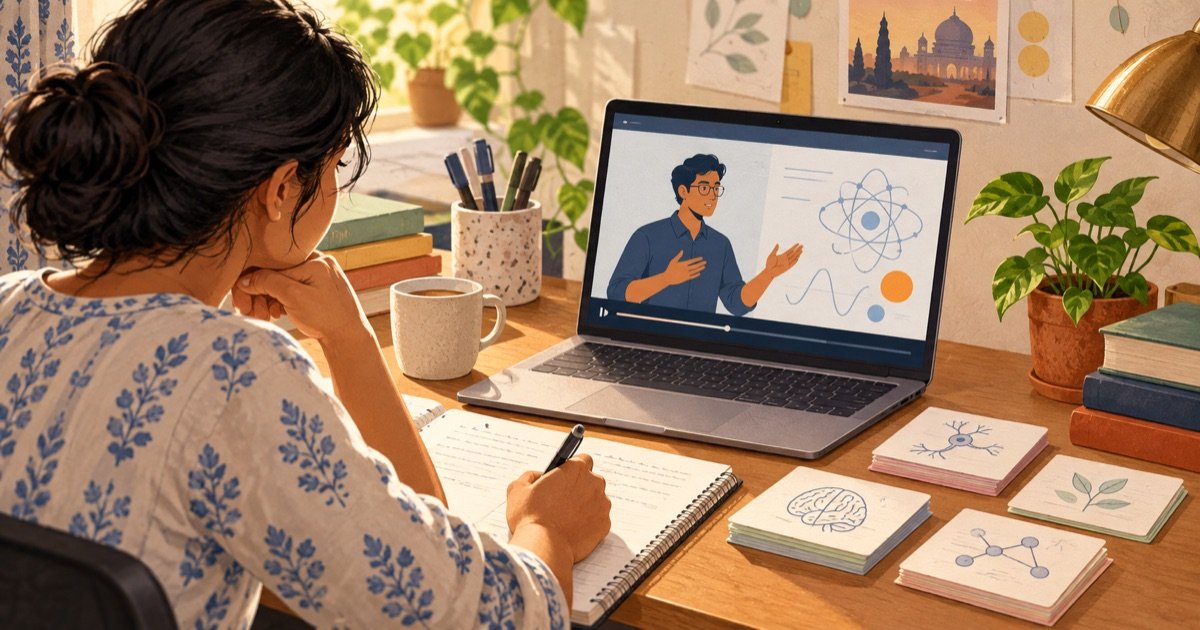
Video lecture notes should help you explain and apply a lesson after the player closes. A long transcript can document what was said without showing what you understood. Build your note around a question, a worked example and a short self-test.
Set a learning target first
Write one thing you should be able to do by the end: solve a type of problem, explain a concept or compare two methods. Connect it to your syllabus or current project. This gives you a reason to pause at important points instead of treating the completion percentage as the goal.
Use three note columns
| Column | What to record |
|---|---|
| Question | The problem this section answers |
| Explanation | Your own concise account and example |
| Check | A task you can attempt without the video |
Add a timestamp for a difficult explanation. This creates a route back to the relevant segment without copying the whole lesson. For a worked calculation, keep the assumptions and units rather than only the final answer.
Use playback controls thoughtfully
YouTube documents transcripts for videos with captions. A transcript can help locate a passage, but verify names, symbols and technical terms against the actual lesson. Playback-speed controls can support pacing where available; faster playback is not evidence of better comprehension.
- Watch a short section with the target in mind.
- Pause and explain it without reading the screen.
- Attempt a relevant question or tiny project step.
- Mark the precise gap if you cannot complete it.
- Return to that segment and revise the note.
Keep a correction trail
Do not silently replace every wrong answer with the correct one. Record the misconception and why the correction works. Before an exam, those notes can reveal what you are likely to repeat under pressure. For a coding lesson, include a small input and the expected output.
Finish with a closed-note check
At the end, answer the original learning target in your own words. If you can repeat a definition but cannot use it, choose another practice task. Ask a teacher or peer about a specific uncertainty rather than saying only that the entire lesson was difficult.
Continue with our study workflow guide and responsible AI learning checklist. Keep the evidence of learning separate from the time spent watching.