
Completing five lessons can feel productive even when you cannot explain the main idea without reopening the video. A useful learning routine needs evidence that survives after the lesson closes: a solved problem, a working example or an explanation in your own words.
This study workflow from Techlein works with an existing course or textbook. It does not require a new paid app. Adapt the timing to your subject and timetable; the sample intervals below are planning suggestions, not a proven universal schedule.
Define one observable outcome
Replace “study spreadsheets” with “build a sheet that calculates a total and explain which cells the formula uses.” Replace “learn this chapter” with “compare its two main ideas and solve one unfamiliar question.” A concrete outcome tells you what to practise and gives you a way to check progress.
Keep the first target small. A learner who is struggling should not have to master an entire chapter before noticing a useful improvement. Record the prerequisite you need if the task is currently too difficult.
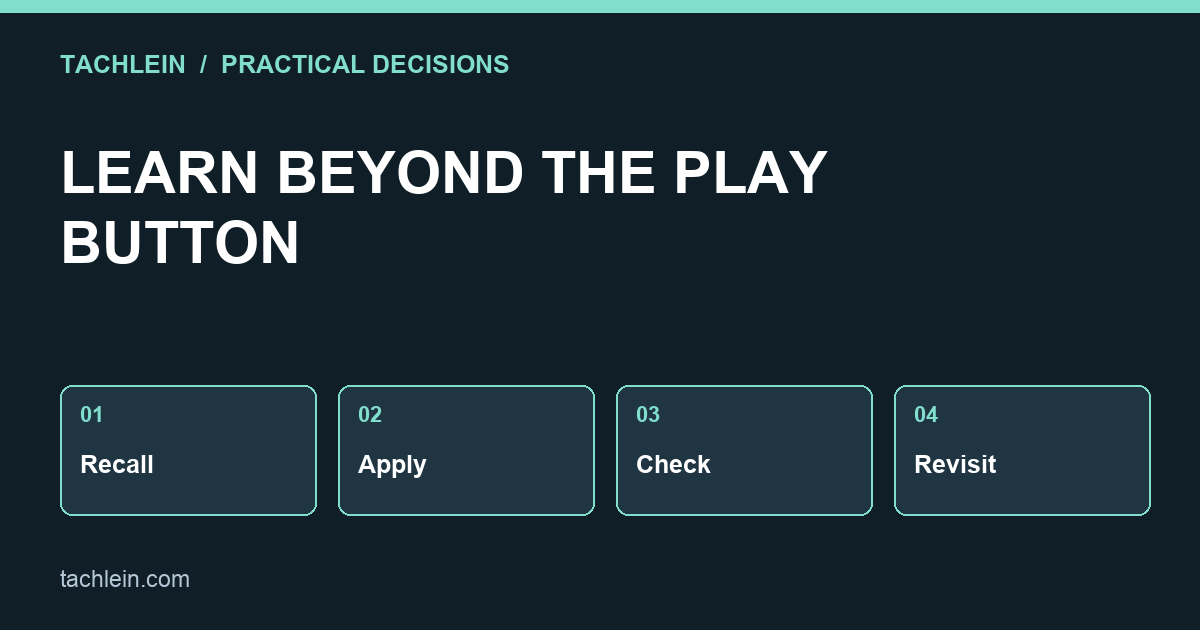
Use a short four-part session
| Stage | What to do | Evidence produced |
|---|---|---|
| Recall | Write what you remember before reopening notes | A visible account of what is available from memory |
| Learn | Read or watch the next relevant section | One corrected idea or new explanation |
| Apply | Solve or build something slightly different | A result that can be checked |
| Review | Compare with a trusted answer or rubric | An error to revisit and a next step |
For a thirty-minute session, you might allocate five minutes to recall, ten to learning, ten to application and five to review. If the application exposes a gap, spend the next session on that gap rather than racing to the next video. The schedule should serve the work, not become another score to maintain.
Make retrieval effort useful
Research on retrieval-based learning examines how actively recalling information can support later learning. The review by Jeffrey Karpicke describes this body of work. It supports trying recall as part of a study routine; it does not guarantee a particular exam result or prove that one schedule is best for everyone.
When recall fails, note the missing piece, check the source, and try again later. Do not repeatedly practise an answer you know is wrong. In subjects with more than one valid approach, compare your reasoning with the marking criteria rather than memorising the appearance of one solution.
Keep a small evidence log
Use six fields: date, target, attempt, error, correction and next check. The attempt should point to something concrete: a paragraph, a sketch, a calculation or a project file. “Watched twenty minutes” describes activity, not necessarily learning.
Example: after a spreadsheet lesson, a student can copy a formula but cannot explain why a reference changes when it is filled down. Their next target becomes comparing relative and fixed references in a tiny practice sheet. That is a more useful outcome than simply watching the lesson again from the beginning.
Use help without outsourcing the thinking
A teacher, classmate or AI tool can help identify a misunderstanding. Ask for a hint or a similar practice question before asking for the full solution. Check important facts and citations against the course’s approved material. Keep submitted work within the course’s rules, and disclose assistance when required.
When an explanation sounds convincing, test it with an example. Can you predict what changes when one condition changes? Can you explain why a plausible alternative is wrong? These checks are especially helpful when a tool produces fluent text that you have not independently understood.
Plan a weekly revisit
At the end of the week, choose a few earlier targets and attempt them without the original walkthrough. Keep successful work as evidence and bring unresolved errors into the next plan. You do not need to revisit everything with equal intensity; focus on the ideas needed for upcoming tasks.
If the routine is becoming too elaborate, simplify the record before abandoning the practice. One honest error and one useful correction can be more informative than a perfectly decorated study dashboard. Progress means doing something more reliably, not only accumulating completed lessons.
Continue with the right Tachlein guide
- choosing a learning app
- using AI without replacing your own work
- Techlein Decision Toolkit: Compare Before You Buy
- Tech Lein Notification Reset: Keep Alerts That Matter
Editorial note: Prepared with AI assistance and checked against the primary sources linked in this guide on 27 October 2026. Examples and worksheets are illustrative; they are not claims of hands-on product testing. Features and terms can change. Use the linked provider guidance for current details.