
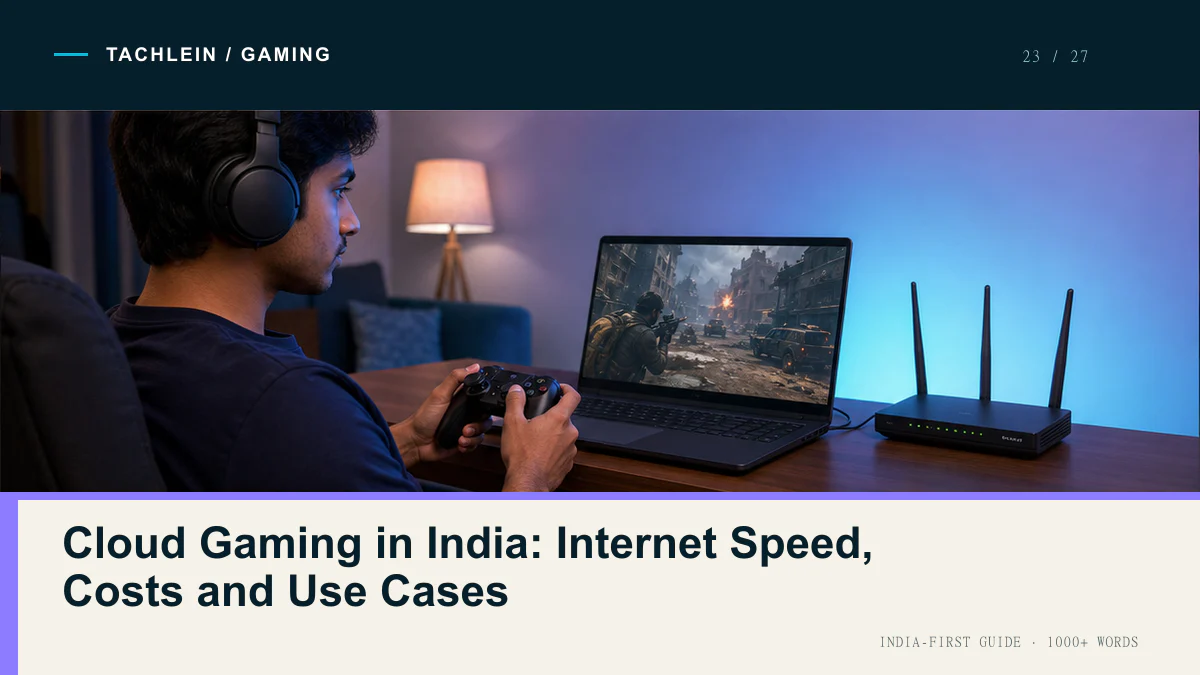
Cloud gaming in India stopped being a thought experiment between November 2025 and April 2026, when Microsoft switched on local Azure regions for Xbox Cloud Gaming and NVIDIA lit up GeForce NOW servers in Mumbai. Before that, every frame you played travelled to Singapore or Frankfurt and back. Now it doesn’t. That single change is why this guide exists — but “it works now” is not the same as “it works for you.”
Be honest about which reader you are
Cloud gaming is a genuinely good deal if: you live in or near Mumbai, Pune, Chennai, Bengaluru or Hyderabad; you have a wired fibre connection of 100 Mbps or more; you mostly play single-player games, story-driven RPGs, racing, sports or co-op titles; and you would otherwise be looking at spending ₹70,000 or more on a machine you use six hours a week.
Cloud gaming will frustrate you if: you play competitive shooters (Valorant, CS2, BGMI) where a 40 ms handicap is the difference between winning and losing a duel; you live in Guwahati, Srinagar, Jammu or most of the Northeast, where the nearest server is still several hundred kilometres and multiple network hops away; your household runs on a shared Wi-Fi connection that someone else is also streaming 4K video on; or you’re on a mobile-data-only plan.
It is not an option at all if: you rely on a metered connection, a plan with a real FUP under 500 GB, or a rural link that drops for a few seconds every hour. A three-second dropout during a Netflix film is invisible; during a boss fight it is a death.
In the second and third cases, a modest local machine still beats a cloud subscription. Our budget gaming setup guide for India covers what ₹40,000–₹60,000 actually buys in 2026.
What you can actually subscribe to from an Indian address
The landscape is smaller than the marketing suggests. Several well-known international services either geoblock India or work only through payment workarounds that breach their terms. Here is the state of play as of August 2026.
| Service | India availability | Monthly ₹ cost | Min speed | Best for |
|---|---|---|---|---|
| NVIDIA GeForce NOW | Live since April 2026, Mumbai RTX servers | Sold as 90-day passes: ₹999 (Performance) and ₹1,999 (Ultimate), roughly ₹333 and ₹666 a month; a free tier exists with queues | 15 Mbps for 720p60; 25 Mbps for 1080p60; 40+ Mbps for the high-tier modes | People who already own a big Steam or Epic library |
| Xbox Cloud Gaming (Game Pass) | Live since November 2025, local Azure regions reported in Pune and Chennai | ₹499 Essential, ₹699 Premium, ₹1,089 Ultimate (tiers and prices have changed twice in a year) | 10 Mbps minimum, 20 Mbps realistic; streams cap at 1080p | People who want a library included, not games they must buy |
| JioGames Cloud | Available, Indian servers, bundled with some Jio plans | Short passes from around ₹48; low monthly equivalent | 10–15 Mbps | Casual and mid-tier catalogue, cheapest way to test the concept |
| OnePlay | Indian operator, India-hosted | Entry tiers from roughly ₹39; AAA and cloud-PC tiers cost considerably more | 15–25 Mbps | Pay-per-play and cloud-PC use, not just gaming |
| Boosteroid | Accessible, but no India data centre | Roughly ₹900–₹1,400 depending on billing currency | 15 Mbps claimed, 25+ realistic | Niche library gaps only; latency is the trade-off |
| Amazon Luna | Not officially launched in India | N/A | N/A | Nobody, for now |
One structural difference matters more than the price column. GeForce NOW is a hardware rental: it streams games you already bought on Steam, Epic, Ubisoft Connect or the Microsoft Store, so if you own nothing you get nothing. Game Pass is a library rental: the catalogue is included, but access ends the day you stop paying. A gamer with a 200-title Steam backlog and one starting from zero should pick opposite services.
Ping is the whole argument, and bandwidth is a red herring
Almost every Indian buyer asks the wrong question first: “Is my speed enough?” Bandwidth decides whether the picture looks sharp or blocky. Latency decides whether the game feels like a game. You can have 300 Mbps and a miserable experience, or 40 Mbps and a superb one.
On a local console, you press a button and the frame changes in roughly 30–60 ms. On cloud, your input travels to the server, the server renders and encodes the frame, sends it back, and your screen decodes it. Every step adds milliseconds, and server proximity is the only lever you control.
Reported round-trip figures from Indian users in 2026 run roughly: single digits to 15 ms in Mumbai and Pune on services with local nodes, 30–45 ms across Delhi NCR, 40–60 ms in eastern India, 80 ms and up in the Northeast. Those are network latency only; rendering and display lag stack on top.
What the ranges actually feel like:
- Under 20 ms: most people cannot tell they are streaming. Everything is on the table, including fast action games.
- 20–40 ms: single-player, racing, sports, RPGs and co-op all feel fine. Precise aiming feels slightly “floaty” but you adapt within an hour.
- 40–60 ms: obvious to anyone who has played locally. Fine for turn-based, strategy, story games and platformers. Genuinely bad for competitive shooters.
- 60–80 ms: only slow games remain enjoyable. You will lose gunfights you should have won.
- Above 80 ms: don’t subscribe. No amount of bandwidth fixes it.
Indian users also underestimate Wi-Fi jitter. A 5 GHz link in the same room is fine; 2.4 GHz through two walls adds 10–30 ms of variable delay and periodic spikes. Jitter is worse than latency, because you can adapt to consistent lag but not to lag that changes every few seconds. Use Ethernet wherever physically possible.
The data bill nobody puts on the pricing page
Cloud gaming is video streaming with a controller attached, and it is thirsty. Documented figures cluster around 7–11 GB per hour at 1080p60 — GeForce NOW is often measured near 9 GB/hour, Xbox Cloud Gaming lower at 5–9 GB/hour thanks to tighter bitrate caps. High-bitrate and 4K modes reach 18–22 GB per hour. Netflix at 4K is roughly 7 GB/hour, so cloud gaming can cost two to three times as much data at the same resolution.
Run the arithmetic against your actual habit:
- 1 hour a day at 1080p (9 GB/h): about 270 GB a month.
- 2 hours a day at 1080p: about 540 GB a month.
- 3 hours a day at 1080p: about 810 GB a month.
- 2 hours a day at 4K/high bitrate (20 GB/h): about 1.2 TB a month, from gaming alone.
Mainstream Jio and Airtel fibre plans now advertise unlimited data, with published fair-usage ceilings on many JioFiber tiers in the multi-terabyte range; on those you are clear even at three hours a day. On an entry-level plan, an AirFiber or 5G home connection, or a regional ISP with a stricter FUP, check the number before subscribing. Being throttled to 2 Mbps on the 20th ends cloud gaming for that month.
Mobile 5G needs its own warning. Raw speed is usually sufficient and latency on a good cell can be respectable, but a 2 GB/day plan buys roughly 13 minutes of 1080p cloud gaming, and evening congestion produces exactly the jitter that ruins the experience. Treat 5G as an occasional away-from-home option. Our explainer on how 5G actually performs in India covers why advertised and real-world figures diverge.
What you still have to buy
“No hardware needed” is marketing. You need less hardware, not none.
A router that isn’t the free one. The single highest-return purchase for a cloud gamer in India is a decent dual-band or Wi-Fi 6 router with a working Ethernet port, in the ₹2,500–₹6,000 range. ISP-supplied units are usually the weakest link in the chain.
A wired controller, or a good wireless one. A Bluetooth controller adds its own 8–15 ms. On a marginal connection that is the difference between “fine” and “annoying.” A USB-C wired connection removes the variable entirely. Budget ₹2,000–₹5,000.
A screen that doesn’t add lag back. Most Indian smart TVs ship in a picture mode with heavy post-processing that adds 60–100 ms of display lag. Find Game Mode in the settings and turn it on; this is free and it is the most commonly skipped step.
A client device. Any Android TV box, mid-range phone, Windows laptop, iPad or smart TV with the app installed will do. This is the real saving: a ₹25,000 laptop that could never run a modern AAA title locally becomes a perfectly good client. If you also want games to run offline, the maths shifts — read our gaming laptop guide for under ₹70,000 alongside this one.
Total realistic add-on cost: ₹5,000–₹12,000 once, versus ₹60,000+ for a capable local machine. That is the actual value proposition.
Test before you pay
You do not have to guess. Fortnite streams free through Xbox Cloud Gaming with no subscription, so you can measure real streamed latency on your own connection at zero cost. GeForce NOW’s free tier does the same, with queue waits attached. Play for thirty minutes on a weeknight at 9 pm, not at 3 am when your neighbourhood is idle. If it feels good then, it will feel good always. Both operators change tiers and regions frequently, so check the official pages first: Xbox Cloud Gaming and NVIDIA GeForce NOW system requirements.
Frequently asked questions
Is 50 Mbps enough for cloud gaming in India?
Yes, for 1080p60 on every service listed here, provided the connection is stable and preferably wired. 50 Mbps comfortably exceeds the 25 Mbps that 1080p streaming needs. What 50 Mbps cannot fix is distance from the server or a congested Wi-Fi link, which is why a Delhi user on 50 Mbps of fibre often has a better experience than a Guwahati user on 300 Mbps.
Can I play competitive games like Valorant or BGMI on cloud?
Technically sometimes, practically no. Competitive shooters are also frequently blocked on cloud platforms because their anti-cheat systems do not permit virtualised environments. Even where a title is available, the added input delay puts you at a measurable disadvantage against locally-hosted players. If ranked shooters are your main genre, buy hardware.
Does cloud gaming work on mobile data or 5G in India?
It runs, but the economics do not. At roughly 9 GB per hour, a typical daily-cap mobile plan is exhausted in minutes, and evening cell congestion introduces jitter. It is usable for a short session on a good 5G connection away from home, not as your everyday setup.
Do I need to buy games separately?
It depends on the service. GeForce NOW streams games you already own on Steam, Epic or other stores, so you buy each title. Xbox Cloud Gaming through Game Pass includes a rotating catalogue at no extra per-title cost, but access ends when the subscription does. JioGames Cloud and OnePlay sit between the two models.
Is cloud gaming cheaper than building a PC in India?
In the first two years, almost always yes. Over four or five years of heavy use, a mid-range PC catches up and then wins, and it leaves you with an asset you own plus offline play, mods and no dependence on your ISP. Cloud gaming makes the most sense for people who play in bursts, travel, or genuinely cannot justify a one-time ₹60,000+ outlay.
The short version
Cloud gaming in India in 2026 is a real product for the first time, not a compromise. If you are in a metro with fibre and you play the kinds of games where 30 ms does not decide the outcome, ₹333–₹1,089 a month replaces a five-figure hardware purchase and does it well. If you are outside the server footprint, on capped data, or a serious competitive player, the technology has not yet arrived for you and no subscription will change that. Test free first, measure at peak hour, and let the result decide instead of the marketing.
Prices, tiers and server locations checked August 2026. Cloud gaming availability in India changes often — Microsoft revised Game Pass tiers twice within nine months, and NVIDIA’s India rollout slipped by two quarters — so verify current pricing on the official pages before subscribing.