
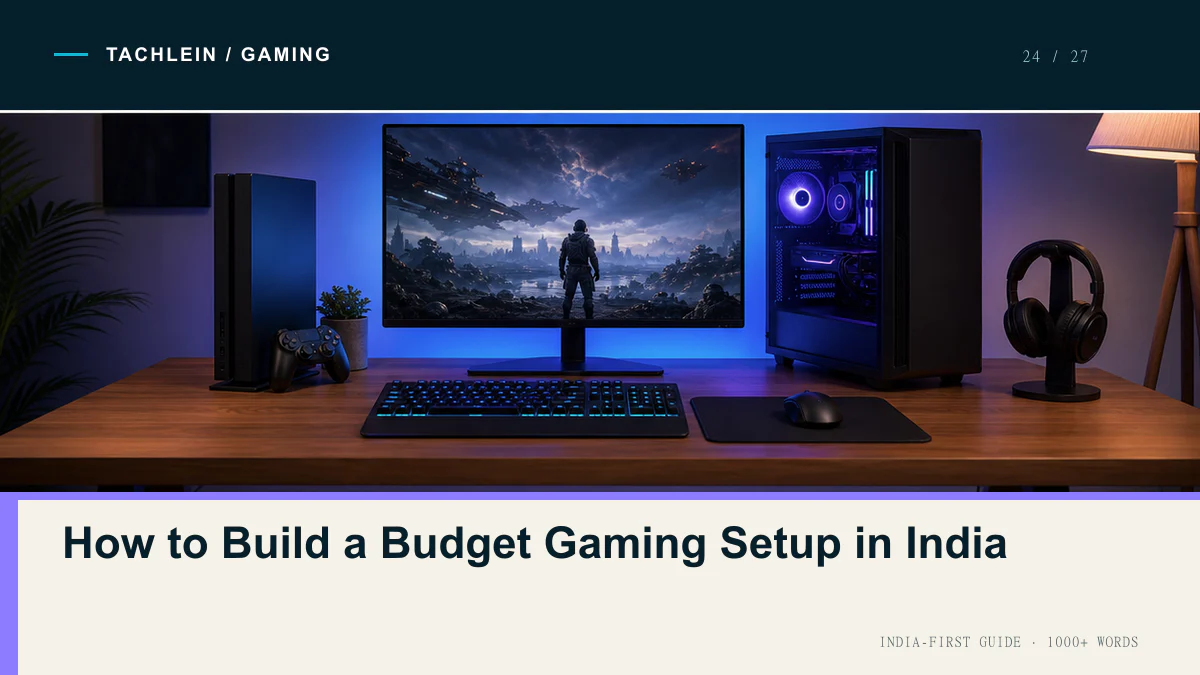
If you have between ₹45,000 and ₹70,000 and you want to game in India in 2026, the honest starting point is that a desktop is not automatically the right answer. Three questions decide it. Do you play mostly competitive titles like Valorant, CS2, BGMI on emulator or Free Fire? A desktop wins, easily. Do you mostly want to play big single-player games with a controller on a TV and never think about drivers? A console is cheaper and less hassle. Are you currently playing BGMI on a phone and wondering if you are missing out? Honestly, for that one game, you are probably not — and a ₹25,000 phone upgrade will improve your BGMI life far more than a ₹60,000 PC will.
This guide assumes you have decided the PC route is worth it, or at least want to see the numbers before deciding. Everything below is priced for the Indian market as of August 2026, which matters more than usual this year, because DDR4 and DDR5 memory has been unusually expensive since the 2025 DRAM crunch. RAM that used to be a rounding error in a budget build now eats ₹8,000 to ₹10,000 of it.
PC, console, or the phone already in your hand?
The BGMI question deserves a straight answer because so many Indian gamers arrive at PC building through it. BGMI is a mobile game. It runs on PC only through emulators like Gameloop, you get matched against other emulator players, and the experience is not meaningfully better than a good phone — it is just bigger. If BGMI is 90% of your gaming, buy a phone with a Snapdragon 7-series or 8-series chip and a 120Hz display, and stop reading. A desktop earns its money the moment you want Valorant at 200 FPS, GTA V, Elden Ring, emulators, mods, streaming, editing, or a machine that will still be useful for college and work.
The console case is equally real. A PS5 Slim Digital sits around ₹39,990 to ₹44,990 in India depending on sale timing, the disc version around ₹49,990 to ₹54,990, and the Xbox Series S has been seen between ₹34,990 and ₹37,990. That is a complete, warrantied, working games machine for less than the ₹70,000 build below. What you give up is free-to-play PC shooters at high frame rates, cheap Steam sales, and any use of the box outside gaming.
The ₹45,000 tier: an APU build, and what it honestly does
Under roughly ₹50,000 in 2026, a discrete graphics card and a decent everything-else do not both fit. The sensible move is to skip the GPU entirely at first and use an APU — a processor with graphics built in — then add a card in six months when you have saved more. The Ryzen 5 5600G is the standard pick for this because its Vega 7 graphics are genuinely playable at 1080p low settings.
| Component | Suggested part | Approx price |
|---|---|---|
| Processor (with graphics) | AMD Ryzen 5 5600G, 6 cores | ₹14,000 |
| Motherboard | A520M or B450M micro-ATX | ₹4,800 |
| Memory | 16GB DDR4-3200, two sticks | ₹8,900 |
| Storage | 1TB NVMe Gen3 SSD | ₹7,000 |
| Power supply | 550W 80 Plus Bronze, known brand | ₹4,600 |
| Cabinet | Mid-tower with 3 fans included | ₹2,600 |
| Tower total | Before monitor and peripherals | ₹41,900 |
Add ₹1,000 to ₹2,000 if a shop assembles it for you, which most Indian retailers will do cheaply or free if you buy the parts there. What this delivers, based on the numbers builders and reviewers publish for this configuration: roughly 80 to 100 FPS in Valorant at low settings, comfortable 60 FPS in BGMI through Gameloop, and about 40 to 55 FPS in GTA V. Modern AAA games at high settings are out of reach. Use two RAM sticks, not one — the integrated graphics borrow system memory and a single stick roughly halves performance.
The ₹70,000 tier: a real graphics card changes the conversation
This is where a budget gaming setup in India stops being a compromise. The jump from integrated graphics to an RTX 4060 or equivalent is the single largest performance step you will ever buy.
| Component | Suggested part | Approx price |
|---|---|---|
| Processor | Intel Core i5-12400F (or Ryzen 5 5600) | ₹12,000 |
| Motherboard | H610M DDR4 (or B550M for AMD) | ₹6,200 |
| Graphics card | NVIDIA RTX 4060 8GB | ₹32,500 |
| Memory | 16GB DDR4-3200, two sticks | ₹8,900 |
| Storage | 512GB NVMe Gen3 SSD | ₹4,800 |
| Power supply | 550W 80 Plus Bronze, known brand | ₹4,600 |
| Cabinet | Mid-tower, mesh front panel | ₹2,300 |
| Tower total | Before monitor and peripherals | ₹71,300 |
That is a shade over ₹70,000, and there are two clean ways to trim it. Swap the RTX 4060 for an AMD RX 6600 at roughly ₹19,000 to ₹21,000 and the total drops to around ₹58,000 while keeping most competitive-game performance. Or drop to an RTX 3050 8GB in the ₹17,000 to ₹19,000 range. Compare current listings on NVIDIA’s India GeForce pages against actual retailer stock before committing, because MRP and street price diverge sharply here.
Expect this build to run competitive shooters at 144 FPS or better at 1080p, and modern AAA titles at high settings between 60 and 90 FPS. The 8GB of video memory is the honest weak point in 2026 — a few recent games force texture compromises at 1080p. If you can stretch, a 12GB or 16GB card is the upgrade that ages best.
Where cutting costs bites back, and where it genuinely doesn’t
The power supply is the one part where a bad decision damages other parts. Unbranded 400W units sold at ₹1,200 routinely fail to deliver anything close to their rating, and a failing PSU can take the motherboard with it. Budget ₹4,000 to ₹5,000 for a Bronze-rated unit from a company with an Indian RMA presence. This is non-negotiable.
The monitor is the second false economy. Pairing a ₹70,000 tower with a ₹6,000 60Hz office panel throws away most of what you paid for. A 24-inch 1080p IPS at 144Hz or higher starts near ₹9,500, and 27-inch 180Hz options land around ₹13,000. In fast games the refresh-rate jump is more noticeable than any GPU upgrade in this price band.
What you can safely economise on: the cabinet, as long as it has mesh airflow and takes three fans; RGB anything; the motherboard, since a basic H610 or A520 board runs a mid-range chip fine as long as you are not overclocking; and storage capacity, since a 512GB SSD today plus a cheap 1TB drive next year is smarter than overbuying now. Skipping an aftermarket CPU cooler is also fine at these tiers — the bundled cooler handles a 5600 or 12400F, though in Chennai or Delhi summers a ₹1,500 tower cooler buys real quiet.
Desktop, gaming laptop, or console: choosing without kidding yourself
A desktop gives the most performance per rupee, upgrades one part at a time, and lasts longest. It also needs a desk, a monitor, and reasonably stable power — a ₹3,000 UPS is worth it in areas with frequent cuts.
A gaming laptop at the same price is meaningfully slower, because mobile chips run at lower power limits and the screen, keyboard and battery consume part of the budget. What you get instead is portability, which matters enormously if you are a hostel student or move often. Around ₹70,000 the laptop tradeoff is roughly one GPU tier down versus a desktop; our gaming laptops under ₹70,000 guide covers which models hold up. If gaming is secondary to coursework, a general-purpose machine from our budget laptops roundup plus a console is often the better combined spend.
A console wins on total cost of ownership and simplicity. Official pricing and current bundles are listed on the PlayStation India site. The catch is game prices — new PS5 titles at ₹4,000 to ₹5,000 add up fast compared with Steam sales, though Game Pass on Xbox Series S offsets much of that. A third option worth pricing before you buy anything: cloud gaming, which shifts the cost from hardware to bandwidth, and which we break down in our cloud gaming and internet cost guide.
Peripherals: budget ₹8,000 and stop there
Peripherals are where budgets quietly leak. You do not need expensive ones. A reliable optical gaming mouse with a decent sensor costs ₹1,200 to ₹2,000 and will outperform anything your aim requires at this level. A membrane or entry mechanical keyboard runs ₹1,500 to ₹3,000, and for competitive shooters a mechanical switch is a genuine advantage over a mushy ₹500 board.
For audio, a ₹2,000 wired gaming headset is fine, but a pair of decent ₹1,500 wired earphones plus a ₹700 clip-on mic often sounds better and is more comfortable in Indian heat. Spend on a mousepad — a large cloth pad at ₹400 is the highest-value ₹400 in the entire setup. Skip the gaming chair for now; a firm regular chair with a cushion costs a tenth as much.
Questions readers keep asking
Can I game on integrated graphics?
Yes, within limits. A modern AMD APU like the Ryzen 5 5600G or an Intel chip with Xe graphics will run Valorant, CS2, Rocket League, Minecraft, older titles and most emulated mobile games at 1080p low to medium settings at playable frame rates. What it will not do is run current AAA releases at anything you would enjoy. Integrated graphics are a legitimate starting point, not a destination — build around one, then add a card.
Is a used GPU safe to buy in India?
It can be, with discipline. The saving is real — often 30 to 40 percent — but so is the risk, since there is no warranty on most private sales. Insist on testing the card yourself: run it under load for at least ten minutes while watching temperatures in GPU-Z or HWiNFO, confirm the reported model matches what the seller claims, and watch for visual artifacts or crashes. Inspect the board for heat discolouration. Amazon Renewed listings with a warranty carry the least risk, established resellers sit in the middle, and OLX or Facebook Marketplace is cheapest and riskiest — pay only after testing, in person.
Should I buy a pre-built PC instead of assembling one?
Pre-builts from Indian system integrators cost roughly ₹5,000 to ₹10,000 more for equivalent parts, and that premium buys you a single point of warranty contact. If you are nervous about assembly or live far from a service centre, it is money well spent. Read the spec sheet closely though — pre-builts commonly hide savings in the power supply and RAM configuration.
Do I need Windows, and does that cost extra?
Budget ₹1,000 to ₹1,500 for a legitimate Windows 11 Home key, or run the free unactivated version, which works indefinitely with cosmetic limitations. Linux gaming through Proton has improved dramatically, but anti-cheat in several popular competitive titles still blocks it, so check your specific games first.
How long will a ₹70,000 build stay relevant?
Roughly four to five years at 1080p if you accept lowering settings over time. The GPU is the first part to feel old, usually around year three. Because a desktop upgrades piecemeal, a ₹25,000 graphics card swap in 2029 resets most of the clock — which is the strongest argument for a tower over a laptop or console.
Prices checked August 2026. Indian component prices move weekly, and memory in particular has been volatile since the 2025 DRAM shortage — always confirm against live listings before you buy.