
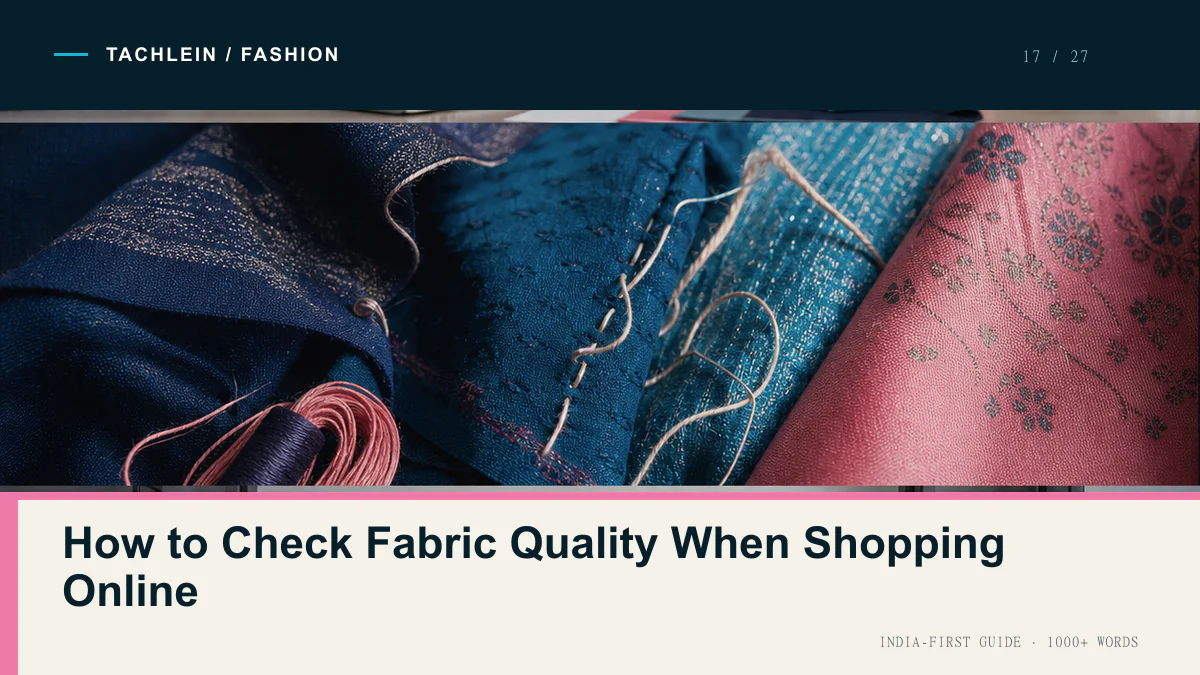
You cannot touch fabric through a screen, but you are rarely as blind as you feel. On almost every Indian listing, three signals do most of the work: the stated fabric weight or thread count, the exact composition percentages, and what a zoomed-in photo reveals about weave and surface. Everything else — brand name, the word “premium”, the discount percentage — is marketing. Read those three, cross-check them against reviews, confirm you can send the thing back, and you will guess wrong far less often.
Fabric weight: what GSM numbers actually feel like
GSM means grams per square metre, and it is the most honest number on a knitwear listing. A 120 GSM t-shirt and a 220 GSM t-shirt can both be “100% cotton” and cost within ₹200 of each other, yet one goes semi-transparent after four washes while the other holds shape for two years.
Indian listings usually print GSM in the “Product Details” accordion. If it is missing on a t-shirt priced above ₹700, that absence is itself information — brands confident about a 200 GSM knit advertise it.
| GSM range | Typical garment | Feels like | Best for |
|---|---|---|---|
| 110–140 | Bulk-print event tees, cheap innerwear, thin kurtas | Papery, see-through against light, clings when damp | Layering, or genuinely disposable use |
| 150–180 | Standard mall-brand t-shirt, summer polos | Light and breezy; drapes rather than stands | Coastal humidity; daily summer wear |
| 180–220 | Good-quality basic tee, henley, casual shirt jersey | Opaque, slight structure, no show-through | The default sweet spot for most Indian wardrobes |
| 220–260 | Oversized and streetwear tees, heavyweight boxy fits | Substantial, holds a boxy shape off the body | Delhi and Bengaluru winters, the drop-shoulder look |
| 280–400 | Sweatshirts, fleece-backed hoodies, joggers | Dense, warm, slow to dry | North Indian winter; too hot for most of the country |
| 400–600 | Bath towels, heavy terry robes | Plush and absorbent; below 400 a towel feels thin | Bath linen; 500–550 is the value point |
Two cautions. GSM says nothing about yarn quality — a 240 GSM tee spun from short, coarse fibres still pills. And higher is not better in Indian conditions: a 250 GSM tee in Chennai in May is a punishment, which is why weight belongs in any serious capsule wardrobe built for Indian weather rather than being treated as a universal quality score.
Thread count, and why 1000 TC bedsheets cost ₹899
Thread count (TC) is threads per square inch of woven fabric, and it is the most systematically inflated number in Indian home-textile listings. The method is simple: brands count plies instead of yarns. Take a genuine 300 TC sheet woven from three-ply yarn, count each ply separately, and you can print “900 thread count” without technically lying. Double-insertion weaving and simple rounding-up do the rest.
Practical translation:
- 200–300 TC in percale or plain weave is genuinely good, breathable and durable — where most sensible purchases live.
- 300–500 TC single-ply cotton is legitimately premium — typically ₹2,500 and up for a double-bed set.
- 600 TC and above under ₹1,500 is almost certainly ply-counted, microfibre, or both. Real high-TC cotton is expensive because long-staple fibre and fine spinning are expensive.
A better signal than TC is the fibre description. “Long staple”, “combed” or “Giza cotton” with a TC in the 200–400 band beats “1000 TC” with no fibre detail every time. If “microfibre” appears anywhere, TC is meaningless — microfibre is polyester, judge it on GSM.
Reading the composition label without flattering it
Under India’s packaged-commodity rules, e-commerce listings must display the same mandatory declarations that appear on the physical label. That makes the composition line the most trustworthy field on the page — but only if you read the percentages, not the adjectives.
“Cotton blend” is the phrase to distrust. It is not a fabric; it is a way of not saying “60% polyester”. Legitimate listings state numbers. When you see only “cotton blend”, “cotton rich” or “premium cotton fabric” with no percentages, assume the cotton share is low enough to be embarrassing.
Polyester is not automatically bad. It earns its place in specific jobs:
- Fine in: gym and running wear, rainwear and outer shells, structured formal trousers that need to hold a crease, printed graphics that need colour retention, and anything you want drying fast in monsoon.
- A problem in: anything worn against skin through an Indian summer. Above roughly 40% polyester traps heat and holds odour — the “smells after one wear” complaint traces almost entirely to this.
The regenerated cellulosics need their own note. Viscose and rayon are the same fibre — drapey and cool, but weak when wet, prone to shrinking and permanent creasing, and often dry-clean-only in practice. Modal has higher wet strength and survives home washing far better. Lyocell or Tencel is stronger still. If a ₹599 “silk-feel” kurta says 100% viscose, expect it to look excellent for six wears and tired by twenty.
Watch elastane too: in jeans, 1–2% gives comfort without bagging, while above 3% they lose shape at the knee within a season.
Weave names tell you how it will behave
The weave is usually buried in the description, and it predicts behaviour better than price does.
- Poplin — smooth, crisp, light plain weave. Formal shirts; creases readily, breathes well.
- Twill — diagonal ribs, heavier and softer, hides wrinkles. Chinos and casual shirts.
- Oxford — basket-textured and sturdy. Durable, less breathable than poplin.
- Jersey — knit, stretchy, smooth face and looped back. Standard t-shirt fabric; judge it by GSM.
- Rib — raised vertical lines, high recovery. Poor rib loses shape at the neckline first.
- Slub — deliberately irregular yarn. Fashionable, but hides cheap spinning well.
Mining the product photos
Photographs are compressed and colour-graded, but the right frames still leak information.
Find the close-up. Most listings carry one macro shot of the fabric or a collar detail. Zoom to maximum and look for clean, defined weave structure. Fuzz, stray fibres or a cloudy surface means short-staple cotton that will pill.
Check any backlit shot. A model standing near a window tells you about opacity: visible outlines through a white tee mean low GSM whatever the specs claim.
Study how it falls. Sharp, standing folds mean structure and weight; fabric clinging limply to the torso is thin or heavily viscose. On bedsheets, find a draped photo rather than a flat styled one — a stiff, plasticky drape usually means microfibre.
Zoom the print border. On graphic tees, thick rubbery plastisol sitting raised off the surface will crack; a print that follows the fabric texture lasts longer.
If an image is too dark to judge, save it and lift the exposure and shadows — several free options among the best photo editing apps do this in two taps, and brightening a shadowed collar shot often reveals seam and stitch quality the styling hid.
Ignore the flat-lay hero image. It is the most retouched frame on the page.
Which review complaints actually predict bad fabric
Review sections are mostly noise about delivery and sizing. Filter for the complaints that are genuine fabric signals.
High-signal complaints — treat as disqualifying if repeated:
- “Transparent”, “can see through”, “thin” — the most reliable fabric complaint there is.
- “Colour bled in first wash” or “faded after two washes” — poor dye fixing, which careful washing cannot rescue.
- “Shrunk after wash”, especially with a stated amount — unsanforised cotton. Size up or skip.
- “Pilling on the sides or underarms within a month” — short-staple fibre or a bad blend.
- “Rough”, “itchy”, “feels like a hospital sheet” — coarse yarn or heavy starch finish.
Low-signal complaints — usually about the buyer, not the fabric: “size too small” (check the size chart), “colour different from photo” (often screen calibration, though repeated mentions of one specific wrong shade are real), “delivery late”, “packaging torn”.
Spotting inflated reviews. Sort by most recent rather than most helpful, and read the three-star reviews first — they are the least likely to be planted and the most likely to be specific. Warning signs: a burst of five-star ratings clustered within days, generic one-line praise with no mention of fit or wash, and a rating spread that is heavily five-star and one-star with nothing in the middle. On Amazon and Flipkart, customer-uploaded photographs are worth more than the text — they show the garment under Indian household lighting after real use.
Sorting out returns before you order, not after
Since you cannot verify fabric until it arrives, the return path is your real protection. Confirm it on the product page itself — windows vary by seller and category.
Broadly: Myntra generally runs a 14-day return and exchange window on apparel, Ajio around 10 days for fashion and 7 for home linen, Amazon commonly 7 to 10 days depending on seller, and Flipkart often offers exchange-only rather than a refund on apparel. Those gaps matter enough to weigh before you settle into one platform, which is covered in our comparison of online fashion shopping sites in India.
Four things to do before paying:
- Read the returns badge on the listing, not the site policy. Third-party sellers frequently set stricter terms than the marketplace default.
- Note category exclusions. Innerwear, swimwear, socks and beauty items are non-returnable across Indian platforms on hygiene grounds, whatever the fabric turns out to be.
- Do not remove tags until you are sure. Every platform requires original tags, packaging and an unwashed, unworn item. Try it on over your own clothes, in daylight, tags attached.
- Film the unboxing. A short video costs nothing and settles wrong-item and damaged-item disputes quickly. Keep it until the window closes.
If a return is refused unfairly, the Consumer Protection (E-Commerce) Rules require marketplaces to display seller and grievance-officer details, and complaints escalate through the National Consumer Helpline. The mandatory pre-purchase declarations for packaged goods sold online sit under the legal metrology rules of the Department of Consumer Affairs.
A repeatable ninety-second check
Open the full specification accordion. Read the composition percentages. Find GSM or TC and sanity-check it against the price. Zoom the closest fabric photo. Sort reviews by recent and scan for transparency, shrinkage and colour-bleed. Confirm the return badge. If three of those six come back weak, close the tab — there is almost always an equivalent listing that answers all six.
Common questions
Is GSM listed for woven shirts too, or only knits?
It appears for both but is far more useful for knits. For woven shirts, Indian listings more often quote yarn count — 40s, 60s, 80s, where higher means finer and lighter. A 40s poplin is a solid everyday shirt; 80s and above is dressier and more delicate.
Does a higher price on an Indian marketplace mean better fabric?
Only weakly. Marketplace pricing is discount-driven and the struck-through MRP is close to meaningless. A ₹499 tee stating 180 GSM combed cotton is a better bet than a ₹1,499 tee stating nothing. Judge the specification sheet first, price second.
How can I tell if a bedsheet listed as cotton is actually microfibre?
Check the composition line first — microfibre is 100% polyester and must be declared. Then the phrasing: listings leading with “wrinkle-free”, “super soft silky”, a very high TC and a low price are usually microfibre. Genuine cotton listings mention weave (percale, sateen) and staple length instead.
What does “pre-shrunk” or “sanforised” mean on an Indian listing?
Sanforised cotton is mechanically pre-shrunk, so it should lose under 2–3% in a home wash instead of the 5–7% raw cotton can lose. If a listing says neither and reviews mention shrinkage, size up and wash cold the first time.
Are fabric swatches or samples available from Indian sellers?
Rarely on the big marketplaces, but often from direct-to-consumer brands and fabric sellers, particularly for made-to-measure shirting and upholstery. If you are ordering several metres or a custom garment, ask the seller on WhatsApp or email — many post a swatch for courier cost, far cheaper than returning a finished order.
Return windows and platform policies shift often. Details above were checked in August 2026; confirm the return badge and specification sheet on the individual listing before ordering, since seller-level terms override platform defaults.