
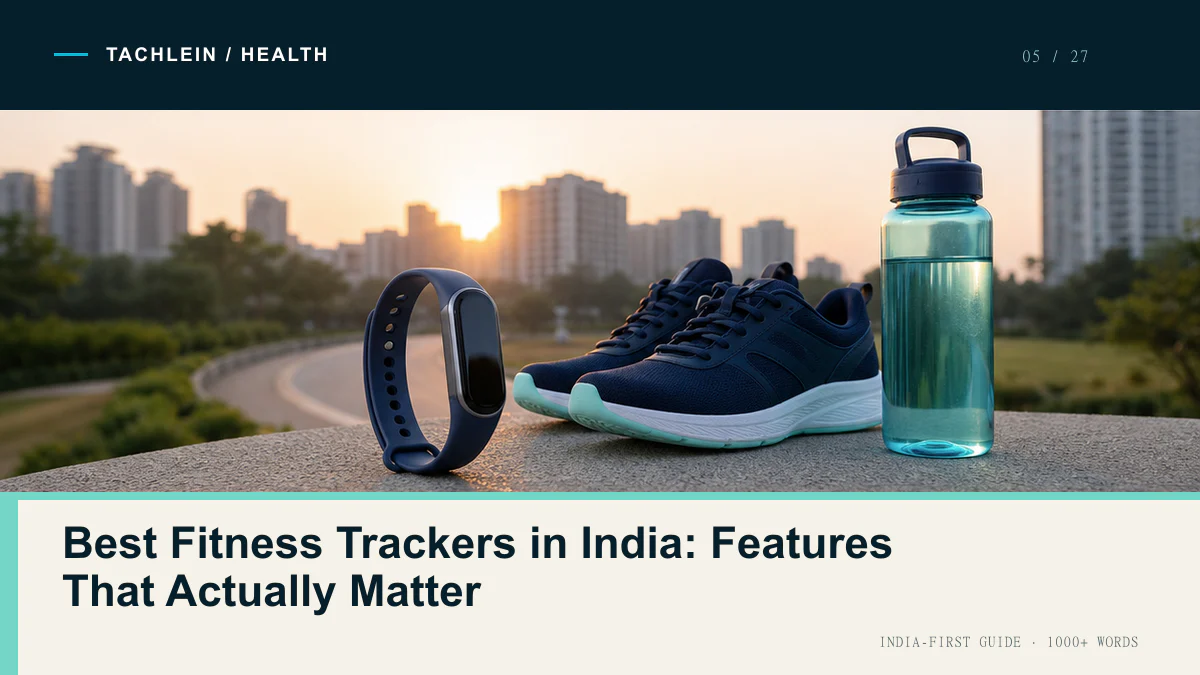
Scroll any Indian shopping app for ninety seconds and you will be told that a wrist device costing less than a decent pair of running shoes tracks your heart, your oxygen, your sleep stages and your stress. Some of that is true. A lot of it is a specification sheet written by a marketing team. This guide separates the two using prices and specifications pulled from official brand pages.
One thing first: a consumer wearable is a wellness gadget, not a diagnostic instrument. None of these devices can diagnose anything, and no number on a wrist screen should be the reason you delay seeing a doctor. If something about your heart, breathing or sleep worries you, book an appointment. We will not tell you how to interpret your own readings, because that is a clinician’s job.
What a fifteen-hundred-rupee band is really selling
The most striking thing about India’s budget tier is not the technology. It is the pricing theatre. On boAt’s own store, the Wave Fury is listed at ₹1,399 against a stated ₹6,999. Fire-Boltt goes further: the Phoenix Air sits at ₹1,299 against a claimed ₹14,999, and the Ninja Call Pro Plus at ₹1,399 against ₹19,999 — a 93 percent “discount” that has clearly never been a real transaction. Noise is more restrained but plays the same game, with the ColorFit Pulse 2 Max at ₹1,599 and the ColorFit Icon 4 at ₹2,099.
Treat the struck-through number as decoration. For ₹1,300 to ₹2,500 you get a bright display, step counting, notification mirroring, a workout timer, and an optical heart rate sensor whose output is a rough trend line rather than a measurement. For someone who wants a nudge to walk more, that is genuinely enough. What you are not buying is sensor engineering, a stable firmware pipeline, or an app still maintained in four years.
Verified India prices, tier by tier
Everything below came from the brand’s own India-facing store or specification page at the time of writing. Wearable pricing here moves constantly, so re-check before you buy.
| Model | Price (INR) | Standout feature | Main limitation |
|---|---|---|---|
| Fire-Boltt Phoenix Air | ₹1,299 | Cheapest route to an always-on step and notification screen | Listed against a fictional ₹14,999 MRP; stock is erratic |
| boAt Wave Fury | ₹1,399 | Large display and call handling at entry price | Heart rate is indicative only; no built-in GPS |
| Noise ColorFit Pulse 2 Max | ₹1,599 | Reasonably consistent firmware for the tier | Connected GPS only — distance depends on your phone |
| Noise ColorFit Icon 4 | ₹2,099 | Metal-finish build at band pricing | No swim-grade water rating claimed |
| Redmi Watch Move | ₹2,499 | Xiaomi claims 14 days of battery life | Basic sensor set; tied to Mi Fitness |
| Redmi Watch 5 Lite | ₹3,999 | 1.96-inch AMOLED with Bluetooth calling | Lifestyle watch, not a training tool |
| boAt Sailor Nav | ₹6,499 | Navigation-oriented flagship of boAt’s own range | Still not an athlete’s device |
| Apple Watch SE 3 | from ₹25,900 | Apple’s health and safety stack at its lowest price | iPhone only; no ECG electrode on the SE line |
| Apple Watch Series 11 | from ₹46,900 | ECG app, blood oxygen, temperature sensing, 50 m water resistance, IP6X | 24 hours of normal use — a daily charger |
| Apple Watch Ultra 3 | from ₹89,900 | Titanium case, depth gauge, longest battery in the range | Overkill for most buyers |
Three absences need explaining. Garmin sells in India through garmin-india.com, listing the Forerunner, Venu, Instinct, vivoactive, fenix and epix families, but we could not confirm current INR pricing on Garmin’s own India pages and will not guess. Samsung’s India site lists the Galaxy Watch Ultra2, Galaxy Watch9, Galaxy Watch8 Classic and the Galaxy Fit line, again without prices we could verify. Fitbit is stranger still: its India URL now redirects to the Google Store’s watches and trackers section, and Charge 6’s own page quotes a US dollar price while bundling three months of Google Health Premium. If you are buying Fitbit in India in 2026, confirm availability and warranty channel before paying.
What the sensors genuinely do
Optical heart rate
Every band here uses photoplethysmography: green LEDs shine into your wrist and a photodiode reads what bounces back. It works well when you are still and the strap is snug. It degrades when your wrist moves hard, when the band is loose, when your hands are cold, and during rapid changes in effort — the classic failure is a flat 120 bpm through intervals, because the algorithm locked onto your cadence instead of your pulse.
Apple, which builds one of the better optical stacks in the business, states in its own support documentation that “Apple Watch may not be able to get a reliable heart rate reading every time for everybody,” and that for a small percentage of users various factors may make a reading impossible altogether. If that is the caveat on a ₹46,900 watch, calibrate your expectations for a ₹1,399 one.
SpO2 and skin temperature
Wrist blood oxygen is a wellness estimate. It is not clinical pulse oximetry, it is not approved for medical decisions, and it is highly sensitive to fit and motion. Skin temperature, where present, is a relative measure — deviation from your own overnight baseline, not body temperature in any medical sense. Both are mildly interesting as multi-week trends. Neither should be used to self-assess an illness.
ECG, and where India actually stands
This is the one real regulatory story in the category. Apple enabled the ECG app and irregular rhythm notifications for India in September 2019, for Apple Watch Series 4 and later. Apple’s own footnotes are unusually direct: the ECG app “does not detect a heart attack, blood clots, a stroke or other heart-related conditions including high blood pressure, congestive heart failure, high cholesterol or other forms of arrhythmia.”
The practical point is that ECG must be both present in hardware and enabled for your region. A watch sold here can have the electrode with the function switched off. Verify on the brand’s India page for your exact model, and be sceptical of any budget device claiming ECG at band prices.
Sleep staging
The tidy pie chart of light, deep and REM is an estimate built from movement and heart rate variability. Total sleep duration and consistency are the parts worth acting on, and wearables get those broadly right. The stage split is the part to hold loosely.
Built-in GPS versus the kind that borrows your phone
This single specification most changes what a device is good for, and it is the one most often blurred. Connected GPS means the watch uses your phone’s fix; leave the phone behind and distance becomes a guess from wrist motion. Built-in GPS means the watch works alone.
Almost everything under ₹5,000 in India is connected GPS, whatever the listing implies. For reference on a serious implementation, Amazfit specifies five satellite positioning systems with a circularly polarised antenna on the Active 2, alongside up to 21 hours of continuous GPS recording.
Battery claims against real weeks
Manufacturer figures are measured with the screen mostly off, always-on display disabled, low-frequency heart rate and no GPS. Enable always-on display and continuous tracking and expect to lose a third to half the quoted number.
Amazfit is refreshingly explicit, publishing separate Active 2 figures: up to 10 days typical, 5 days heavy use, 19 days in battery saver, 21 hours of continuous GPS. That 5-to-19-day spread for one device is the honest shape of every battery claim here. Xiaomi’s 14-day Redmi Watch Move figure follows the same rules. Apple quotes 24 hours of normal use for Series 11 and 38 hours in Low Power Mode, with about 80 percent charge in 30 minutes — a device you charge while you shower.
Water ratings and what survives a pool
IP and ATM ratings are not interchangeable. IP68 covers dust and static immersion — sweat and monsoon rain, yes; swimming, no. A 5 ATM rating tested to ISO 22810:2010, as Amazfit specifies for the Active 2, is the threshold for pool use. Apple rates Series 11 at 50 metres with IP6X. Almost no sub-₹3,000 Indian band carries a credible swim rating regardless of box art.
Choosing by how you actually move
Walking and general fitness
The ₹1,500–₹2,500 tier does this job. The Noise ColorFit Pulse 2 Max at ₹1,599 or the Redmi Watch Move at ₹2,499 are sensible: readable screens, long battery, no pretensions. Do not pay extra here for SpO2 or a “stress score”.
Running
Built-in GPS is non-negotiable, which puts your floor above the band tier. This is where Garmin’s Forerunner line and Amazfit’s Active family belong — the Active 2’s 21-hour continuous GPS figure is real training-watch territory. A ₹1,400 connected-GPS band will consistently mis-measure your long runs.
Gym and strength work
Wrist devices are weakest here. Rep counting is unreliable, and optical heart rate is at its worst under load because of wrist flexion and grip pressure. Buy for the timer, the log and notifications; if heart rate matters, pair a chest strap, which most mid-range watches accept over Bluetooth.
Swimming
Insist on 5 ATM or 50 metres stated on the manufacturer’s own specification page. The Apple Watch Series 11 and Amazfit Active 2 clear that bar; a ₹1,599 band almost certainly does not, and buttons not designed for water will trigger themselves in the pool.
Notifications and long battery, nothing else
Buy the cheapest well-reviewed AMOLED band with the largest quoted battery and switch every health sensor off. The Redmi Watch Move’s 14-day claim is aimed precisely at you.
Testing your own device before you trust it
- Steps against a manual count. Walk 200 counted steps. Within five percent is fine; 20 percent out means it is guessing.
- Distance against a known route. Use a 400 m track. This exposes connected-GPS devices immediately.
- Resting heart rate against a counted pulse. Sit still five minutes, then compare the watch against a radial pulse counted over 60 seconds, on three mornings. Consistency matters more than any single figure.
If a device fails the distance check, it is a step counter and a notification screen. That may be all you wanted — but price it accordingly.
The app, the paywall and what happens if the brand leaves
The sensor is what you see. The app is what you live with, and that is where long-term cost sits. Amazfit states there are no hidden subscription fees for Zepp’s core functions, with an optional Zepp Aura Premium tier for extended sleep reports and an AI sleep coach. Apple keeps health data on-device and in iCloud with no separate health subscription. Garmin Connect has historically been free for core analysis, with a paid Connect+ tier for extras. Fitbit devices now sit inside Google’s health ecosystem, and Charge 6 ships with three months of Google Health Premium bundled — which tells you the direction.
Ask one question before buying: can you export your full history, in a standard file, without paying? Indian buyers need a second, because this market has seen brands arrive, discount hard and vanish. If a company exits India the watch keeps counting steps, but the app stops being updated, cloud sync can be switched off, and years of history become unreachable. Budget-tier apps are the most exposed. Export periodically, and prefer a platform with a real global installed base if you want data that lasts.
Service and warranty, the part nobody reads
Budget Indian brands typically offer a one-year limited warranty handled by courier: you ship it, they assess it, you wait. Straps, displays and water damage are commonly excluded, and at ₹1,400 replacement is often cheaper than repair. Premium brands maintain physical service infrastructure, which is part of what the extra money buys. Keep the GST invoice, buy from an authorised seller, and check whether your model is serviced in your city rather than only in a metro. Grey-market Garmin and Samsung units circulate here at attractive prices and frequently carry no valid India warranty.
Questions readers keep sending us
Is a ₹1,500 tracker a waste of money?
No, if you buy it for what it is. As a step counter, clock, notification screen and mild behavioural nudge it works. As a heart rate monitor or running distance tracker it will disappoint you.
Does ECG work on watches bought in India?
It depends on the model and on regional enablement, not just hardware. Apple enabled the ECG app in India from September 2019 for Series 4 and later. For other brands, confirm on that brand’s India page for your exact model.
Can I use SpO2 readings to check on an illness?
No. Wrist blood oxygen is a wellness estimate, sensitive to fit and movement, and is not a medical measurement. If you have a health concern, see a doctor.
Do I need a subscription?
For core tracking, generally no. Amazfit states no hidden subscription fees for Zepp’s core functions, and Apple and Garmin both provide substantial analysis without a paid tier. Subscriptions increasingly gate coaching, advanced sleep analysis and long-range trend reports.
How much does built-in GPS really matter?
For walkers, barely. For runners and cyclists it is the difference between a training tool and a toy. Almost everything below ₹5,000 in India is connected GPS.
How long should a tracker last?
Budget bands realistically give two to three years before battery degradation and app abandonment catch up. Brands with global scale tend to support software considerably longer.
Where we would put the money
Mainly want to walk more? Spend ₹1,500 to ₹2,500 and expect a step counter and a notification screen. If you run, skip the budget tier and buy built-in GPS — the only specification here that reliably changes how you train. If you swim, insist on 5 ATM or 50 metres stated on the manufacturer’s own page. And if you are buying for heart features, choose a brand that publishes regional availability and limitations as plainly as Apple does, then take the data to a doctor rather than a search engine.
Our sourcing approach and how we handle product claims are set out in our editorial standards, and you can read more about us on our about page.
Official pages we checked
- Apple India — Apple Watch pricing
- Apple — Series 11 specifications
- Apple India Newsroom — ECG in India
- Apple Support — heart rate on Apple Watch
- Amazfit — Active 2 specifications
- Noise — official India store
- boAt — official smartwatch collection
- Fire-Boltt — official smartwatch collection
- Xiaomi India — smart watch and audio store
- Garmin India — official site
- Samsung India — Galaxy Watch range
- Google Store India — watches and trackers